About Rotary Flask Shaker
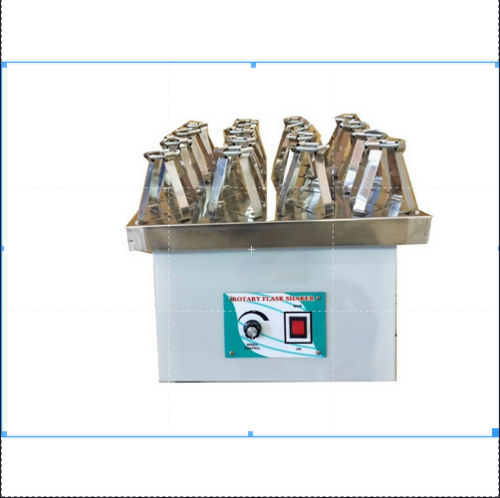
A Rotary Flask Shaker is a laboratory instrument designed for mixing and agitation of liquid samples in glassware, typically flasks, using orbital or reciprocal motion. Here's a concise overview:
- Purpose Used for various applications including culturing, mixing, and extraction processes in biological, chemical, and pharmaceutical laboratories.
- Features Equipped with adjustable speed controls, timers, and sometimes temperature controls to optimize mixing conditions for different types of samples.
- Types Available in different sizes and capacities to accommodate various flask sizes and sample volumes.
- Applications Widely used in microbiology for bacterial and yeast culture growth, in chemistry for chemical reactions requiring agitation, and in pharmaceutical labs for drug formulation and testing.
- Importance Essential for achieving uniform mixing and efficient oxygen transfer in liquid cultures, which is crucial for maintaining cell viability and maximizing yields in biotechnological processes.
In summary, Rotary Flask Shakers are indispensable tools in laboratory settings where precise agitation and mixing of liquid samples in flasks are required for research, development, and production purposes.
| Size |
Medium |
| Voltage |
230 |
| Country of Origin |
Made in India |
Enhanced Versatility & CapacityThis shaker offers the flexibility to mix a wide range of flask sizes, ranging from 100 ml to 1000 ml. With a maximum load capacity of 12 kg and the ability to hold up to 9 large or 16 smaller flasks, it's optimized for busy laboratory environments, ensuring efficient processing of multiple samples in a single run.
Reliable Construction For Laboratory UseBuilt from heavy-duty mild steel with a durable epoxy powder coating, the RS-1000 ensures longevity and easy maintenance. Its anodized aluminum platform paired with stainless steel clamps provides secure support for flasks throughout extended mixing cycles. The belt-driven motor operates quietly at less than 60 dB, making it suitable for shared laboratory spaces.
User-friendly Controls with Safety FeaturesThe analog rotary knob enables precise speed adjustment, ensuring reproducible results with 5 rpm accuracy. Safety is prioritized with IP20 protection and overload safeguards, protecting both users and equipment during continuous operation. Manual, benchtop installation allows straightforward integration into laboratory workflows.
FAQ's of Rotary Flask Shaker:
Q: How do I adjust the mixing speed on the Rotary Flask Shaker RS-1000?
A: The mixing speed can be easily adjusted using the analog rotary knob on the control panel, allowing you to select speeds between 20 and 250 RPM to suit your laboratory requirements.
Q: What flask sizes and quantities can the platform accommodate?
A: The shaker platform supports flask sizes from 100 ml to 1000 ml, fitting up to 9 flasks of 1000 ml or 16 flasks of 500 ml per operation, with a maximum load capacity of 12 kg.
Q: When is this rotary flask shaker most beneficial in laboratory settings?
A: It is ideal for continuous mixing and agitation of flask cultures during microbial growth, chemical reactions, or general laboratory sample preparation requiring consistent agitation.
Q: Where should the RS-1000 Rotary Flask Shaker be installed?
A: Designed for benchtop installation, the RS-1000 fits easily in most laboratory settings, occupying a footprint of approximately 1100 x 600 x 400 mm for streamlined integration into workspace layouts.
Q: What safety features does this equipment provide during operation?
A: Safety is ensured with built-in overload protection, IP20-rated enclosure, and reliable control mechanisms to prevent equipment damage or operator risk during use.
Q: How does the belt-driven motor affect shaker performance and noise?
A: The quiet belt-driven motor ensures consistent, accurate shaking action with a noise level below 60 dB, making it suitable for laboratories where minimal disturbance is required.
Q: What are the primary benefits of using the RS-1000 for flask agitation?
A: The shaker's robust construction, variable speed control, high capacity, and reliable safety features deliver efficient, reproducible results, supporting a wide range of laboratory mixing applications.







 Send Inquiry


 Send Inquiry
 Send Inquiry
 Send SMS