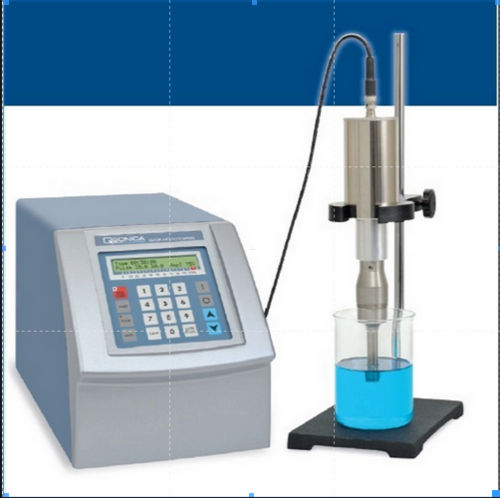
About Probe Sonicator
An ultra probe sonicator is widely used in pharmaceutical laboratories for various applications, including: Homogenization: Breaking down particle sizes to create uniform mixtures. Cell Disruption: Lysing cells to extract intracellular contents. Emulsification: Creating stable emulsions of immiscible liquids. Dispersion: Distributing nanoparticles evenly in suspensions. Degassing: Removing dissolved gases from liquids. These processes are crucial for the preparation and formulation of pharmaceutical products, ensuring consistency, efficacy, and quality of the final products.
| Phase |
single phase |
| Voltage |
230V |
| Country of Origin |
Made in India |
Advanced Ultrasonic Cell DisruptionEngineered for laboratory use, the ST-500 Probe Sonicator delivers efficient and reproducible cell disruption, homogenization, and emulsification. Controlling ultrasonic power, amplitude, and operation time through an intuitive touch panel enables users to tailor the process for varied sample types and volumes. The instrument is ideal for life sciences, pharmaceutical, and chemical research, offering accuracy within 1%.
Integrated Noise Control & Safety AssuranceA built-in soundproof enclosure significantly reduces operational noise, enhancing lab safety and comfort. The system's comprehensive safety suite-automatic overload shutdown and overheat protection-helps safeguard samples and equipment alike, ensuring consistent results and peace of mind for operators.
FAQ's of Probe Sonicator:
Q: How do I set the ultrasonic power output and amplitude on the ST-500 Probe Sonicator?
A: The ST-500 allows you to adjust the ultrasonic power output between 150 and 500 W and the amplitude from 20% to 100% using the digital touch panel. Simply select your desired values before starting your process to match your sample requirements.
Q: What types of samples can this sonicator process, and what is the maximum capacity?
A: This probe sonicator is designed for processing a variety of laboratory samples, including liquids, suspensions, and cell lysates. It can handle sample volumes ranging from micro-liters up to a maximum of 500 ml.
Q: When should the noise reduction enclosure be used during operation?
A: The integrated noise reduction enclosure should always remain closed while the sonicator is running to minimize noise exposure and enhance user safety in the laboratory environment.
Q: Where is the ST-500 suitable for use, and what are its typical applications?
A: The ST-500 is suitable for use in laboratory settings, including life science, pharmaceutical, and chemical research labs. It is commonly used for cell disruption, homogenization, emulsification, and dispersion tasks.
Q: What process controls and safety features does the sonicator include?
A: The device comes equipped with programmable timer settings up to 99 minutes, adjustable amplitude, and power controls. Safety features include automatic shutdown in case of overload and overheat protection, safeguarding both users and samples.
Q: How does the air-cooled system benefit the ultrasonic sonication process?
A: The air-cooled system efficiently dissipates heat during prolonged operation, maintaining optimal performance and preventing equipment overheating, which extends the lifespan of the instrument.






 Send Inquiry


 Send Inquiry
 Send Inquiry
 Send SMS