About Lab Incubator
An incubator is a crucial piece of equipment used in laboratories to create and maintain controlled environments for biological cultures, cell lines, and microorganisms. Here's a concise overview:
- Purpose Incubators provide a stable and controlled environment with regulated temperature, humidity, and often CO2 levels, ideal for the growth and experimentation of biological samples.
- Applications They are used extensively in microbiology, cell biology, biotechnology, and pharmaceutical research for tasks such as cell culture, microbial culturing, embryo development, and biochemical assays.
- Key Features Modern incubators typically include programmable temperature settings, humidity control systems, HEPA filtration for sterile air circulation, and often CO2 control for maintaining physiological pH levels in cell cultures.
- Types Incubators vary in size and design, from small benchtop models suitable for basic cell culture to large-scale units used for industrial applications and high-throughput screening.
Incubators are indispensable tools in life sciences research, ensuring optimal conditions for the growth and study of biological materials essential for advancing scientific understanding and medical research.
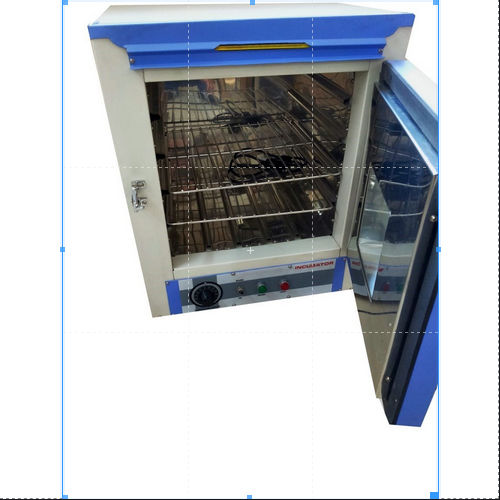
Robust Construction and Superior InsulationEngineered with a stainless-steel inner chamber and powder-coated mild steel exterior, this incubator ensures durability and corrosion resistance. The double-wall construction with high-grade glass wool insulation minimizes heat loss and maintains a stable environment inside. The insulated double-walled door, fitted with a glass window, allows convenient monitoring of samples without compromising thermal integrity.
Easy-to-Use Manual Controls and Efficient OperationWith a manual capillary thermostat, users can easily set the desired temperature within the 5C to 60C range. The analog display provides clear visibility of internal conditions, and the air jacketed heating method guarantees even temperature distribution. Operation is straightforward, making it suitable for users at all experience levels, and power consumption remains low at approximately 200W.
Flexible Shelving and User-Friendly DesignThe incubator includes two removable perforated trays, enabling versatile sample arrangement and efficient air circulation. Lightweight and compact in size, it is easily portable and fits comfortably in various lab environments. The supplied accessories, including a user manual and power cord, facilitate quick installation and immediate use.
FAQ's of Lab Incubator:
Q: How do I operate and set the temperature on this lab incubator?
A: To operate the incubator, connect it to a 220V power source using the supplied cord. Set the desired temperature (within 5C to 60C) using the manual capillary thermostat. The analog display shows the internal temperature, and over-temperature protection ensures safe usage.
Q: What are the benefits of the double-walled insulated design?
A: The double-walled insulated construction with high-grade glass wool ensures minimal heat loss and greater temperature stability. This results in consistent incubation conditions, energy efficiency, and reduced operating costs for laboratory procedures.
Q: When should the removable perforated trays be used?
A: The two perforated trays can be used whenever you need to organize or separate multiple samples inside the incubator. Their removable design offers the flexibility to adjust the internal arrangement based on sample size or workflow requirements.
Q: Where can this lab incubator be installed, and is it portable?
A: Due to its compact dimensions (410 x 300 x 320 mm) and lightweight build (approx. 20 kg), this incubator can be easily placed on most laboratory countertops or work surfaces. Its portability allows users to relocate it as needed within the lab environment.
Q: What is the process for maintaining the incubator?
A: Regularly clean the inner stainless-steel chamber with appropriate laboratory cleaners and ensure the removable trays stay free from contamination. Periodically inspect seals, the thermostat, and the heating element to maintain optimal operation.
Q: How does the air jacketed heating method enhance the incubator's performance?
A: The air jacketed heating method ensures uniform temperature distribution throughout the chamber, preventing hot spots and ensuring all samples are incubated under consistent conditions.








 Send Inquiry


 Send Inquiry
 Send Inquiry
 Send SMS